
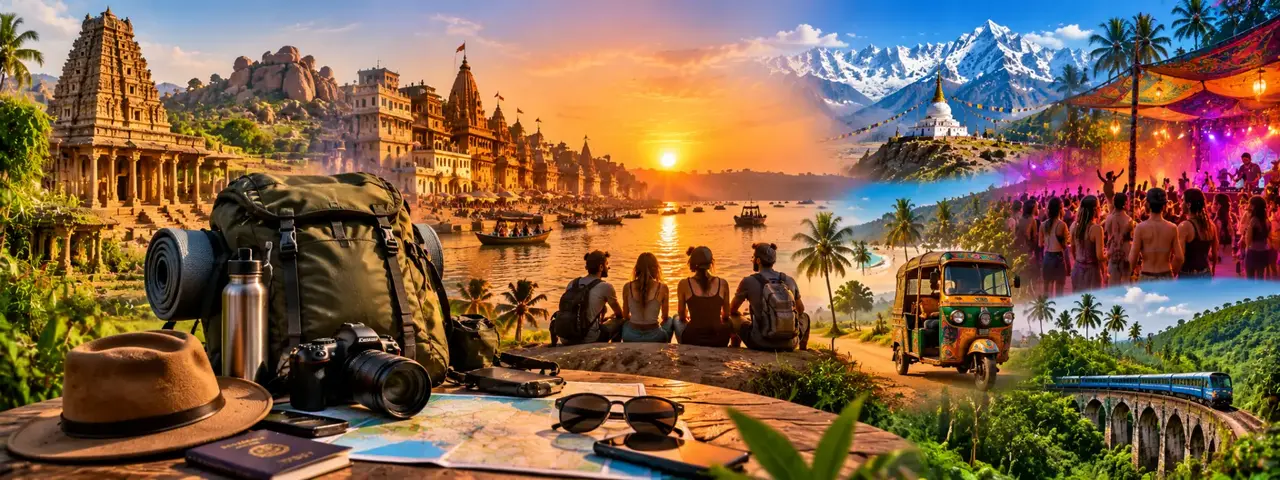


The Republic of India (Hindi: भारत गणराज्य, Bharat Ganarajya) is a country in South Asia occupying most of the Indian subcontinent.
Published by the Traveling in India website team on 15:51 | 02/08/21India is the world's seventh-largest country by area and its second most populous (after China), with over a billion people speaking more than a hundred languages. India has a democratic system of government, making it the world's largest democracy.
India is divided into twenty-eight states (each further divided into districts), seven union territories and one national capital territory—Delhi. State governments are locally elected, while union territory administrations are appointed by the central government. India has over 7,000 kilometers of Indian Ocean coastline and borders Pakistan to the west; Nepal, the People's Republic of China and Bhutan to the northeast; and Bangladesh and Myanmar to the east. It is also close to several island nations in the Indian Ocean: Sri Lanka, the Maldives and Indonesia. India's economy is the world's third largest and is growing rapidly.
As the birthplace of the Indus Valley civilization and a hub of major trade routes and empires, India has played a key role in human history. Hinduism, Sikhism, Buddhism and Jainism all originated here, while Islam and Christianity became widely influential in later periods. In the 19th century, India was a colony of the British Empire. It gained independence in 1947 after a prolonged struggle that was at times violent.
An officially declared nuclear-armed state and a regional power, India has the world's third-largest military by personnel.
History
The oldest evidence of a literate civilization found in India belongs to the Indus Valley civilization, studied at the sites of Harappa and Mohenjo-daro. Its script remains undeciphered, but archaeological finds reveal a highly developed civilization that traded with Mesopotamia. This civilization gradually disappeared, and between the beginning and middle of the 2nd millennium BCE, Vedic culture emerged and spread. Its people were probably nomads who arrived in the Indus River region, mostly in present-day Pakistan, and spread eastward to the plains between the Indus and the Ganges. How they spread remains disputed, with a minority of scholars arguing for cultural continuity with the Indus Valley civilization. These tribes were called Arya, and scholars have proposed various theories about their origins, based mainly on linguistic research. Their religion was set out in the Sanskrit Rigveda and developed into a religious canon. Over the following millennia, it evolved into the conceptual and symbolic core of the beliefs now known as Hinduism.
Islam reached India in the early 11th century with Muslim invasions and the conquest of the Indus and Ganges valleys. Most Indians did not accept Islam, as its ideas and practices differed greatly from those of Hinduism, the prevailing religion in India at the time.
By the 16th century, Muslim invasions of India had become commonplace, as they had been for 100 years. Some invaders stayed, while others returned west with as much loot as they could carry. But Babur (meaning tiger), the Mongol ruler, stayed in 1526. He founded the Mughal Empire, one of the world's most magnificent empires. His royal court was filled with wealth, with men and women wearing precious jewelry and fine silk clothing.
The Maratha Empire was founded in southern India in 1674 and lasted until 1818, when it surrendered to the British Empire. British rulers regarded India as their most important territory. This view, among other considerations, led to the construction of the Suez Canal.
In 1770, about ten million people died in a devastating famine in Bengal. It was caused by the shift to growing opium on farmland, forced on local farmers by the British East India Company as part of its strategy to export opium to China. This led to a deadly food shortage for the local population. Another major famine struck the region in 1943, killing about three million people as a result of failures in food distribution.
India's long struggle for independence formally began in 1885 with the founding of the Indian National Congress. The movement found a great leader in Mohandas Karamchand Gandhi. A British-trained lawyer, Gandhi used nonviolent protests, which he called "satyagraha," to oppose British rule in India. His followers would sit motionless in the streets, even when beaten by police. Gandhi urged them not to buy British goods or work for the British. He spent several years in prison and frequently went on hunger strikes. In 1919, British troops opened fire on a group of Indians holding a satyagraha protest in Amritsar, killing 400 unarmed people. This event is considered a turning point in India's independence struggle. The struggle eventually succeeded, and Viceroy Lord Louis Mountbatten announced that British rule would end on 14 August 1947. However, the country would be divided into Hindu India and Muslim Pakistan, contrary to Gandhi's vision of Muslims and Hindus living together in a united India. After astrologers warned of bad luck on the planned independence day, India's independence was declared the following day, 15 August 1947. India's first prime minister, Jawaharlal Nehru, declared: "At the stroke of the midnight hour, when the world sleeps, India will awake to life and freedom."
The month after Partition saw bloody population exchanges between the two new countries. Some 4 million Hindus and Muslims moved their homes across the border. Around half a million people were killed in the ensuing Hindu-Muslim riots. Through hunger strikes, Gandhi managed to stop the riots in Kolkata and Delhi, but in 1948 he was assassinated by a Hindu extremist who considered his approach to Muslims too lenient.
Since the two countries declared independence, Kashmir has remained fiercely disputed between India and Pakistan. Just days after independence, the first Indo-Pakistani war began. It lasted from 1947 to 1949 and centered on the region's future. The ceasefire left India in control of two-thirds of the territory. Further wars centered on Kashmir took place in 1965 and 1971. Although Pakistan lost most of the battles, the region's future remains unresolved, with terrorist attacks and local border clashes between the armies continuing. This has caused persistent instability between India and Pakistan and, from the late 90s, fueled a nuclear arms race alongside UN efforts to resolve the conflict peacefully.
Since independence, India was governed by the Indian National Congress, the party of Jawaharlal Nehru and Mahatma Gandhi, first under Nehru, then his daughter Indira Gandhi and his grandson Rajiv Gandhi. The exceptions were two brief periods in the seventies and eighties, and the period beginning in 2014, when the Bharatiya Janata Party came to power under Narendra Modi.
Prime Minister Nehru governed until his death in 1964. Under his leadership, India pursued industrial expansion focused on heavy industry through a series of five-year plans. His foreign policy emphasized neutrality, and India became a leading member of the Non-Aligned Movement.
In the 90s, India underwent economic liberalization and reform, opening its economy to international trade and investment. Domestic politics also changed, as old loyalties based on caste, religion and ethnicity gave way to numerous small regional parties.
Politics
Under its constitution, India is a "sovereign, socialist, secular and democratic republic." Like the United States, it has a federal system of government. However, India's central government is more powerful than its states and follows the British model. It can dismiss state governments when no party can form a government or when certain constitutional provisions apply. It can also impose direct federal rule on a state, known as President's Rule.
The government exercises broad executive powers on behalf of the president, whose role is largely ceremonial. The president and vice president are indirectly elected every 5 years by a special electoral college. The vice president assumes the presidency if the serving president dies or resigns.
India's parliament (known as Sansad) has two houses: the upper house, Rajya Sabha (Council of States), and the lower house, Lok Sabha (House of the People). The Council of Ministers is accountable to the Lok Sabha.
Naval offices in New Delhi, between the Prime Minister's residence and the Ministry of Defence. The columns topped with ships represent four Commonwealth nations: Australia, New Zealand, South Africa and Canada
National executive power rests with a council of ministers (cabinet), led by India's Prime Minister. As in Israel, the President appoints the person nominated by a majority of Lok Sabha members as Prime Minister. This majority may come from a single party with an absolute majority or a coalition of parliamentary parties. The President then consults the Prime Minister and appoints ministers who report to the Prime Minister. In practice, the President has no discretion in choosing the Prime Minister unless no party or coalition holds an absolute majority in the Lok Sabha. Once the Prime Minister is appointed, the President has no discretion over other matters, including ministerial appointments. However, all central government decisions formally bear the President's name. Keep this in mind when reading about "decisions made by the President."
Local Government
India is divided into 28 states, each further divided into districts, 7 union territories, and one national capital territory—Delhi. Each state has its own elected government headed by a Chief Minister, while each territory is governed by an administrator appointed by the central federal government. Some state legislatures have two houses, like the national parliament.
Economy
Since independence, India's government followed a socialist approach involving centralized state control and regulation of private enterprise, partly because of its economic dependence on the Soviet Union. The collapse of the Eastern Bloc in the early 90s led to liberalization in India, reducing government controls on foreign investment while privatizing companies, particularly those owned by state governments.
As of 2014, India's GDP ranked fourth worldwide in purchasing power parity terms, after the European Union, China and the United States, and 9th in nominal terms. However, annual per capita income was only about 1,688 dollars (about 6209 dollars in purchasing power parity terms), and 37% of the population lived below the poverty line. India's workforce numbers nearly half a billion people. India is one of the BRICs—the four largest emerging economies of the 2000s. GDP growth in 2006–2007 was among the world's highest, at over 9% annually, but fell slightly to around 7% following the global economic crisis of 2008–2010. Inflation rose above 9%. Foreign investors are increasingly investing in India's growing economy and stock market.
India's currency is the Indian rupee, divided into one hundred paise. As of January 2019, one US dollar was worth about 70 Indian rupees.
Indian crafts sold by children
The main economic sectors are:
-
Agriculture employs over half of India's workforce but contributes only about 15% of GDP. Around two-thirds of India's land is suitable for farming. Despite agricultural modernization and mechanization, around two-thirds of workers still work in agriculture. India meets most of its own agricultural needs and exports products such as tea, basmati rice and spices.
-
Industry employs about 14% of the workforce and contributes around 28% of GDP. Major industries include textiles, automobiles, machinery and chemicals.
-
The services sector employs about 34% of the workforce and contributes around 57% of GDP. India is a major outsourcing destination for companies worldwide, particularly for computer programming and English-language call centers. Many international technology companies, such as IBM, have large centers in India, as do Israeli technology firms such as Amdocs and Ness Technologies. India has two scientific bases in Antarctica: Maitri and Dakshin Gangotri.
As of 2008, India had over a million families earning more than 100,000 dollars a year and 27 billionaires, including Lakshmi Mittal and Mukesh Ambani, who ranked among the world's ten richest people in 2009 according to Forbes. In 2013, India's billionaire count rose to 55, compared with 37 in the UK and 22 in Japan.
Geography
India is in South Asia, covers 3,287,590 square kilometers and occupies most of the Indian subcontinent. The subcontinent is a peninsula surrounded on three sides by the Indian Ocean and lies on the Indian Plate, part of the Indo-Australian tectonic plate. India shares land borders with Pakistan, China, Bangladesh, Myanmar, Nepal and Bhutan.
India is divided into the following regions: the Himalayas, the great river plains, the Thar Desert and the Deccan Plateau.
India's capital is New Delhi. Other major cities include Kolkata (formerly Calcutta), Mumbai (formerly Bombay), Chennai (formerly Madras), Bangalore, Ahmedabad, Hyderabad, Kanpur, Nagpur, Pune, Lucknow, Agra and Varanasi.
Climate
Most of India has a monsoon climate. There are three main seasons: relatively cool and dry (October to February), hot and dry (February to June), and hot and rainy (June to September). Monsoon rains during the rainy season often cause flooding, loss of life and property damage. Rainfall varies greatly across India: Cherrapunji, near the Bangladesh border, recorded 24,555 mm in 1995 (a world record), while the Thar Desert receives 100–500 mm annually.
Demographics
Table of India's states and territories, ranked by population:
Rank | State/Territory Name | Population in March 2005 |
|---|---|---|
1 |
Uttar Pradesh | 166,197,988 |
2 |
Maharashtra | 96,878,958 |
3 |
Bihar | 82,998,697 |
4 |
West Bengal | 80,877,550 |
5 |
Tamil Nadu | 62,405,999 |
6 |
Madhya Pradesh | 60,348,023 |
7 |
Rajasthan | 56,507,188 |
8 |
Karnataka | 52,850,562 |
9 |
Gujarat | 50,671,017 |
10 |
Andhra Pradesh | 49,665,533 (2011) |
11 |
Odisha | 36,804,660 |
12 |
Telangana | 35,193,978 (2011) |
13 |
Kerala | 31,841,374 |
14 |
Jharkhand | 26,945,829 |
15 |
Assam | 26,655,528 |
16 |
Punjab | 24,358,999 |
17 |
Haryana | 21,144,564 |
17 |
Chhattisgarh | 20,833,803 |
18 |
National Capital Territory of Delhi | 13,850,507 |
19 |
Jammu and Kashmir | 10,143,700 |
20 |
Uttarakhand | 8,489,349 |
21 |
Himachal Pradesh | 6,077,900 |
22 |
Tripura | 3,199,203 |
23 |
Manipur | 2,166,788 |
24 |
Meghalaya | 2,318,822 |
25 |
Nagaland | 1,990,036 |
26 |
Goa | 1,347,668 |
27 |
Arunachal Pradesh | 1,097,968 |
28 |
Union Territory of Puducherry | 974,345 |
-- |
Union Territory of Chandigarh | 900,635 |
27 |
Mizoram | 888,573 |
28 |
Sikkim | 540,851 |
-- |
Union Territory of the Andaman and Nicobar Islands | 356,152 |
-- |
Union Territory of Dadra and Nagar Haveli | 220,490 |
-- |
Union Territory of Daman and Diu | 158,204 |
-- |
Union Territory of Lakshadweep | 60,650 |
-- |
India's Total Population in 2001 | 1,028,610,328 |
Religion
India is religiously diverse, and many Indians see no contradiction between some of its faiths. For example, many Buddhists in India also consider themselves Hindu.
The largest religious group is Hinduism, whose various traditions and sects account for 80.4% of the population. India has a large Muslim minority, making up about 13.4% of the population. Other faiths include Christianity (2.3%), Sikhism (1.9%), Buddhism (1.5%) and Jainism (0.5%), alongside Zoroastrians, Baha'is and followers of folk religions. India once had large Jewish communities, mainly in Maharashtra, home to the Bene Israel and Iraqi Jewish communities. Kochi had several communities, chiefly the Malabari and Paradesi Jews. After 1948, most members of these Jewish communities immigrated to Israel, and today only a few thousand Jews remain in India.
Hinduism
Hinduism has a profound influence on life and culture in India, particularly through the caste system. This system divides people into four "varnas," or colors, each representing a social class with its own rights and duties. Alongside the varnas is the system of "jatis," or occupational groups, which divides people by profession. Today, Hindu society has around 3,000 different jatis.
The highest varna is the "white varna" of the Brahmins, spiritual leaders and interpreters of the sacred Vedic texts. The second is the "red varna" of the Kshatriyas—kings, rulers and warriors. The third is the "brown varna" of the Vaishyas, including merchants, farmers and artisans. Finally comes the "black varna" of the Shudras, the class of servants and slaves. Below and outside the varna system are the Dalits, sometimes called "untouchables," who have no assigned color or status and are considered "impure."
Despite constitutional provisions for affirmative action, members of lower castes, those considered "impure," and tribal communities still tend to work in jobs regarded as degrading and face humiliation from other Indians.
Like followers of most Eastern religions, Hindus believe in reincarnation: a person's soul passes through successive lives and finds no rest until it merges with Brahman, ending the cycle of rebirth.
The main Hindu deities are Brahma, creator of the world; Vishnu, preserver of the universe; Shiva, the force of destruction; and the mother goddess Mahadevi, whose forms include Kali, Parvati, Lakshmi and Durga. In Hindu belief, most animals are sacred, especially the cow. It must not be harmed or eaten, as it is regarded as a nurturing, life-sustaining mother.
Culture
Film and Television
Indian cinema is among the most developed in the world, with an enormous film industry: India produces around 900 films a year, more than any other country—even Hollywood, which produces only about 300 films a year. The industry is centered in Mumbai and is known as "Bollywood". The first Indian film was made in 1913 by Govind Palke, considered the father of Indian cinema.
Most Indian films cater to audiences with a mix of action, romance, music and a divine struggle against evil. This type of film is called masala, after the Indian spice blend. Music plays a central role in most films, and songs from their soundtracks often become popular pop hits across the country. Films are recorded in 2 or 3 languages to reach a wider audience.
India has dozens of television channels, many of which broadcast worldwide.
Indian Cuisine
As India is a subcontinent, it is difficult to define a typical Indian cuisine. Food varies significantly between the south and north, between Hindu and Muslim communities, and in many other ways. In general, Indian food is based on pulses and vegetables, served with bread, rice or both. Common seasonings include ginger, garlic, onion, cardamom, turmeric, coriander, cumin, curry leaves, cinnamon and garam masala spice blends.
Food is often served on a thali platter.
India's Jewish Community
India's Jewish population now numbers only around 5,000 (about half in Mumbai, around 1,500 in Thane, 300 in Pune, and just a few dozen in Kochi, Kolkata and New Delhi). Until a few decades ago, the community numbered around 30 thousand.
Indian Jews traditionally worked in oil production, later moving into light industry and then into the security forces and government, where some rose to senior positions. They took part in India's independence movement and, when Israel was established in 1948, emigrated there in large numbers.
Mumbai's Jewish community receives ongoing support from organizations such as the Joint Distribution Committee, the Jewish Agency, ORT and the Hazon Eli Association. Chabad members are active locally, mainly among Israelis and tourists from around the world.